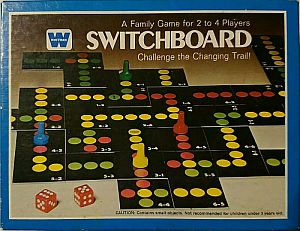
Switchboard
1966 (c) Carlton B. WilderAGES:
None ListedHOW MANY PLAYERS:
2 to 4 PlayersEQUIPMENT:
36 Tiles4 Tokens
Dice
Instruction Sheet
OBJECT OF THE GAME:
To be the first player to land on the final spot.SUMMARY OF PLAY:
The playing surface consists of 36 tiles laid out numerically to form a square. Each tile contains spots which form a pathway; some form straight paths, some are angled paths and some form crossroads. As players advance their tokens along the paths, they also move tiles in an attempt to bottle up opponents while building the shortest possible path to the Finish for themselves. Thus, the pathway is continuously shifting, branching out, and breaking into segments.BEFORE PLAY:
Arrange the 36 tiles in the center of the playing surface as shown below. Each player selects a token. Determine who will start; play passes to the left.PLAY:
Each player, at his turn, will do the following:1. Roll the dice.
2. Move his token the number indicated by the dice total.
3. Shift a tile (optional).
Each player starts in the upper left hand corner as shown above. The first player enters the path at tile 1-1. Following players enter at this point also, but they may find the pathway extended. See TILES.
TOKENS:
Tokens may be moved in any direction, forward or back, but only one direction for each roll of the dice. If it is possible to move the full count of the dice, a token must be moved. If the token cannot go either forward or back, the total of the dice, it cannot move at all. A player who cannot move may still shift a tile if he wishes.TILES:
The tile to be shifted is indicated by the dice roll. Players will usually have a choice between two tiles unless doubles are rolled. Example: dice roll is 4 and 5. Move token 9 spots forward or back if possible, shift tile 4-5 or tile 5-4. Shifting a tile is always optional, and the tile may be placed anywhere on the playing surface as long as it makes at least one pathway connection.If any player’s token rests on the tile to be shifted, the token is moved along with the tile.
SPOT COLORS:
Player who lands on a green spot is entitled to another turn.Player who lands on a red spot loses his next turn.
Player who lands on a yellow spot is neutral; he neither takes an extra turn nor loses his next turn.
BUMPING:
If a player’s token lands on an opponent’s token, he must bump (move) the opponent’s token to any yellow space on any tile. He may then, if he wishes, turn that tile in place, perhaps disconnecting the pathway completely, or directing the opponent down some disadvantageous pathway.TO WIN:
The winner is the first player to land on the finish spot by the exact count.TYPICAL GAME BEGINNING:
First player rolls 2 and 3. He moves spaces onto the pathway starting at tile 1-1 and arriving at the second space of tile 2-1. He may then shift either tile 2-3 or tile 3-2 to any place he chooses, so long as the pathway connects.STRATEGY HINTS:
Play defensively! Look for ways to bottle up your opponents. Try to place them in dead-end situations. Keep in mind that anyone rolling 3 and 4 on the dice may shift the tile containing the finish spot. When bumping, you may want to bump the opponent to a yellow space of a tile already occupied by another opponent. Thus, when you turn the tile in place, you disconnect both opponents! Play offensively too! Try to build your own private pathway, including green spaces which allow you extra turns and increase your chances of getting the finish tile near your own token.1966 (c) Carlton B. Wilder
