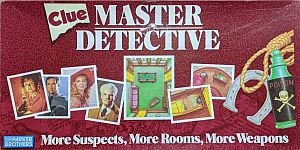
A Brief History of the World’s Favorite Mystery Game
In 1946, a solicitors’ clerk from Birmingham, England, paid a visit to the firm of Waddingtons Games Ltd., in Leeds. Anthony E. Pratt and his wife had come, with a couple of game-inventing friends, to present their idea and prototype of a mystery detection game to the game manufacturers. They met and played the game with some Waddingtons employees while the firm’s managing director looked on.
Fortunately for all of us, the people at Waddingtons liked what they saw and agreed to produce the game. Only three years later, Parker Brothers brought the game to American mystery lovers — and it’s been a family favorite ever since!
Why “CLUE®”?
That’s elementary, my dear Watson! Because the object of the game is to collect enough clues to solve the mystery.But when this classic game was created in England, it was called “CLUEDO.” Now that one takes a bit more explaining.
What we Americans call PARCHEESI, Britons call LUDO (pronounced “lew-doh”), which simply means “I play” in Latin. So when Waddingtons Games Ltd., agreed to produce Anthony Pratt’s new board game, they made a play on words: “LUDO” became “CLUEDO.” And in more than 40 countries around the world, it’s known either as CLUEDO or by the American CLUE name.
Who’s Who?
Speaking of names, how do you suppose Mrs. Peacock and Colonel Mustard fare in other nations? You’d be surprised — because she is a he, and he is a she!In Norway, Mrs. Peacock is called Baronesse von Blauw, but in Spain she’s Capitano Azurro, a man. And Colonel Mustard is Swiss as Madame Curry.
In Germany, the exotic Miss Scarlet is called Fraulein Ming. In Switzerland she’s got a more ordinary name, Evelyne Rose, but she does have the distinction of being the only CLUE suspect in the world whose suspect card bears a first name!*
Spanish players call Professor Plum, our absent-but-murderously-minded professor, Dr. Mandarino. Meanwhile, the Swiss have more insight into his character: They call him Docteur Dunkel!
And what of our resident corpse, whom we Americans aptly call Mr. Boddy? The Britons who invented him call him Dr. Black. In Spain he’s Dr. Lemon. In Switzerland, either Herr Kludo or Monsieur Cluedo, depending on which part of the country you’re from. But the U.S.’s special set of Spanish rules have hit the nail on the head: They call him Sr. Caddaver!
What would the rest of the world make of our four new suspects — Sergeant Gray, Madame Rose, Monsieur Brunette and the lovely Miss Peach?
*In our Suspect Dossiers we've given most of our perpetrators first names - to help flesh out their characters!
The Manor of Murders
For nearly 40 years, since the CLUE game was introduced in the U.S., the unfortunate Mr. Boddy has been murdered daily at Boddy Mansion. In the CLUE MASTER DETECTIVE version, he’ll meet his end at his little country place, Boddy Manor.
In this new game, there are three additional possible murder locations and some other new rooms as well, as befits a man of Mr. Boddy’s stature. But, despite concern expressed by fans over the years, there are still some amenities we have not added to his house — but other countries have.
Specifically, for years Parker Brothers has been asked where everyone sleeps, since there are no bedrooms. Concerned players also wonder why such an elegant house has never had a bathroom. Well, the compassionate Spanish and the efficient Swiss have taken care of both. Dr. Lemon — alias Herr Kiudo or Monsieur Cluedo — as they call him, has both a bedroom and a bathroom in their versions of the game. Since for years he’s had a garage in Spain, at his CLUE MASTER DETECTIVE estate we’ve added a Carriage House, complete with a couple of horses — always handy for a cross-country get-away!
What’s behind the CLUE Popularity?
Ask many people their favorite type of book, they might allude to the latest Nobel Prize winner’s tome on their bedside table. But interrogate them further, and they’ll confess they love a good mystery! And what movies have been tops at the box office recently? Suspense thrillers, especially ones with a real twist at the end.
But why do people love a good mystery? Could it be the foreign locales? The fascinating perpetrators and suspects? The sheer ingenuity of the writer who pulls all the personality quirks and clues together to present a neat solution at the end? Bestselling mystery novelist Mary Higgins Clark has said: “I like to see justice triumph. My sense of orderliness demands it. The world is chaotic. There’s a catharsis in having order restored. That’s why so many people read mysteries.”*
But whether you’re a fan of Ms. Clark and Agatha Christie or prefer the psychological probings of Patricia Highsmith ... whether you think Dick Francis is on the right track or you like your sleuths hard-boiled, like Raymond Chandler’s Sam Spade or Robert B. Parker’s Spenser ... or whether you’d rather put your feet up and watch Perry Mason or Sherlock Holmes solve the crime on TV, there’s no lack of good mysteries to chose from. They provide escape and enjoyment, as you use your little grey cells to collect clues along the way and try to figure out Whodunit before the author tells all at the end.
For nearly four decades, mystery devotees have had but one motive for playing the CLUE — and now CLUE MASTER DETECTIVE — games: You get to pretend you’re Sherlock Holmes, Nancy Drew, Charlie Chan and Miss Marple, all rolled into one. And there are so many possibilities of Who, Where, and With What Weapon, that the mystery changes every time you play. You can experience the escape and enjoyment of playing a game while you’re solving a problem by asking the right questions, collecting the right information and making the correct deductions in order to solve the mystery. Unlike other games, these two depend on a lot more than blind luck to win.
So, as that Belgian master detective Hercule Poirot would say, “Let’s exercise our leetle grey cells.” Then he might just add:
"Let's solve a CLUE MASTER DETECTIVE MYSTERY"!"
*from an interview in the Boston Globe.
Rules for Play
OBJECT
Mr. Boddy of Boddy Manor has met with grave misfortune: He’s been murdered by a person unknown, somewhere in or around the manor house, with an as-yet-undetermined weapon. It’s up to you, the CLUE MASTER DETECTIVETM player, to determine Whodunit? Where? With what weapon?
Even if you’re a veteran clue-finder, you’ll have to exercise your “little grey cells” to solve each CLUE MASTER DETECTIVE mystery, because now there are 10 possible perpetrators, 12 possible scenes of the crime, and 8 possible weapons.
So put away your violin, put on your deerstalker hat, fill your meerschaum pipe, and start sleuthing! If you’re a master detective, the solution will be elementary!
EQUIPMENT
Game board showing 13 locations inside and outside Mr. Boddy’s manor house • 10 Colored tokens, each representing a suspect • 2 Dice • 8 Weapons • Pack of 30 illustrated cards: 10 Suspects, 12 Locations, 8 Weapons • Pad of Detective Notebooks • Envelope marked “Case File — CONFIDENTIAL”
SETUP
1. Each player selects a token representing one of the Suspects. All tokens are placed in the Cloakroom to start, regardless of the number of players. (The murder never occurs in the Cloakroom — it’s the 13th Location.)
2. Regardless of the number playing, bring out all 8 Weapons and place them together in a spot off the playing board. You’ll learn when to use them later.
3. Sort the pack of 30 cards into three piles — Suspects, Locations and Weapons. Shuffle the three groups separately and put them face down on the board; select the top card from each and, without looking, slip these three cards into the “Case File — CONFIDENTIAL” envelope and set it aside. The envelope now contains the answers to the questions: Who? Where? How?
4. Mix the remaining cards together and shuffle them well. Deal them all out, starting with the player on your left. Some players may receive more cards than others; this doesn’t matter. With these cards in your hand, you have begun your investigation because you know that if you hold these cards, they can’t be in the CONFIDENTIAL envelope.
5. Each player takes a sheet from the Detective Notebook pad and folds it in half — to keep the information secret from the other players. If you wish, mark on the pad all the cards you hold in your hand.
6. Each player rolls the dice; play will proceed to the left, and the highest roller starts.
In the words of the greatest master detective of them all, Sherlock Holmes:
"The game is afoot!"
GAMEPLAY
Note: Aside from its additional Suspects, Locations and Weapons, the CLUE MASTER DETECTIVE game includes a feature not found in the classic CLUE® game. It’s the ‘Snoop Spaces” — those squares marked with a spyglass  on the board. Before you begin to play, be sure to read the section below that tells you how to snoop.
Your objective is to move around Mr. Boddy’s manor, going in and out of the 12 possible murder Locations. Each time you enter a room or an outside location, you may “Make a Suggestion” and gather valuable information about what cards are in your opponents’ hands. When you have figured out what cards each of the other players holds in his or her hand, and knowing what’s in your own hand, you can deduce which three cards are in the Case File by process of elimination.
So set off on the trail of the murderer by...
Moving Your Token
On each turn, move towards, into, or through one of the 12 Locations by 1) rolling the dice, or 2) using a Secret Passage, or 3) a combination of both.
1. Rolling. If you roll the dice, move that number of spaces, either horizontally, vertically, forwards or backwards (but not diagonally). You may change directions as many times as your roll will allow; however, you may not enter the same square more than once on the same turn. You may not land on a square occupied by another token: If your dice roll would land you there by exact count, you must stop one space behind the other player’s token; if you rolled a higher number, jump over the other token, counting the occupied space as part of the roll, and move the total number of spaces rolled.
2. Secret Passages. These Locations are connected: Drawing Room and Conservatory; Library and Kitchen; and Basement Stairs and Garden Walk. you are in any one of these spots at the beginning of a turn and wish to use the connecting passage, announce that you’re going to do so, and move your token to the Location at the other end of the passage.
3. Combination. You may also use a Secret Passage as part of a roll of the dice. Roll and move your token into the Location where the passage starts; move through the passage, counting it as one space, and exit into the Location at the other end; either stay there or complete your move by exiting.
When Entering or Leaving a Location
• You do not have to land in a Location by exact count.
• Do not count a door as a space.
• You may pass through a Location on a turn, counting it as one space. However, you may not leave a Location if you have made a suggestion on that turn.
• You may not re-enter a room on the same turn.
Snoop Spaces... Nine spaces on the board are marked by a spyglass that looks like this: As part of your move, you may land on one of these spots and “Snoop” an opponent. Announce which player you want to “Snoop,” then draw one of his or her cards, sight unseen, look at it, mark what you’ve learned on your Detective Notebook sheet, and give the card back. If you have not used up your dice roll, continue your move.
MAKING A SUGGESTION
Once you’ve entered a Location, you may — and should — make a suggestion in order to learn what cards your opponents hold. To do so, move a Suspect token (one being used by another player or a spare one from the Cloakroom) and a Weapon of your choice into the Location. You may, of course, name your own token as a Suspect. Now suggest that the murder was committed in that Location by that Suspect with that Weapon.
For example: “I suggest the crime was committed by Miss Peach in the Gazebo with the Poison.”
EXTRA CLUES ON MAKING SUGGESTIONS
1. You may, if you wish, make a Suggestion and an Accusation on the same turn.
2. After entering one of the Locations, you may make only one Suggestion. To make another, you must wait until another turn when you are in a different Location or, sometime after your next turn, re-enter the Location you most recently left. You may not forfeit a turn to remain in a particular spot.
3. You may make a Suggestion that includes a Weapon and/or Suspect token that’s already in your location. If you do need to move a Weapon or token into place, leave them there after your Suggestion; do not move them back where they were before you moved them.
4. If another player moved your token to a new Location in order to make a Suggestion, on your next turn you may either move out of that Location in one of the usual ways, or you may make a Suggestion from that Location. If the latter, you do not roll the dice or move your token.
5. There is no limit to the number of Suspect tokens or Weapons that may be in one Location at the same time.
PROVING A SUGGESTION
Beginning with the player on your left, make your Suggestion. If he has any one of the cards mentioned in your suggestion, he hands you that card; if he has more than one of the cards you asked for, he selects which one to show you. Look at the card, mark the information on your Detective Notebook, then return the card.
If you’ve been shown a card or not, move on to the next player and make your Suggestion again. If she holds one of the three cards in your Suggestion, she shows it to you; again, if she holds more than one you mention, she selects which one to show. Proceed around the table, asking each player.
If none of the other players has the cards you asked for, you may either end your turn, OR you may make an Accusation.
MAKING AN ACCUSATION
“When you have eliminated the impossible, whatever remains, however improbable, must be the truth.” —Sherlock Holmes
When you think you’ve solved the mystery, you may, on your turn, make an Accusation. Announce that “It was (Suspect) in the (Location) with the (Weapon).” Now, look at the cards in the Case File envelope. If you’re right on all three counts — Whodunit, Where and How — YOU WIN!
If you’re wrong about any of the cards, put the cards back in the envelope —without letting anyone else see them. You’ve lost your chance to win, and you take no more turns yourself. But you still answer Suggestions made by the remaining players, and others may still move your token into locations when they make Suggestions.
Remember: To make a Suggestion, you must be in the Location you name. To make an Accusation, you may name any Location without actually being in that place.
STRATEGY HINTS FOR THE SUPER SLEUTH
1. Don’t Forget to Snoop... especially when your dice roll is large enough to snoop and enter a Location on the same move.
2. Making Suggestions. You may want to name one or more of your own cards in order to gain information ... or mislead your opponents.
3. Proving a Suggestion. It is possible on one turn to be shown all three cards; however, this is not an advantage, because all the players heard you make your Suggestion, and everyone will know that those three cards are not in the Case File envelope. This is another reason you may want to include one of your own cards in the Suggestion.
4. Your Detective Notebook. Be sure to note what you’ve learned on your Detective Notebook. You may find it helpful to put the initials of which players showed you which cards.
5. Sneaky Move. If an opponents token appears to be heading to an important Location, on your turn you may want to include that Suspect in a Suggestion in order to move him or her away from that Location.
WINNING
The first player who correctly names all three cards in the Case File envelope wins, and lays the cards face up on the table as proof.
