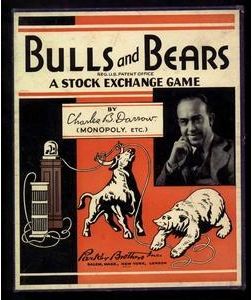
BULLS AND BEARS
A PARKER TRADING GAMECopyright 1936 By PARKER BROTHERS, INC.
Salem, Mass., New York, London
BRIEF IDEA OF THE GAME
BULLS AND BEARS is based on the buying and selling of stocks in order to profit, either by a rise in the prices of stocks held, or by receipt of income in the form of dividends. Players hope, as in real life, that the prices of their particular holdings of stock will rise or that they will be able to “corner" a stock and force the other players to be penalized. Players buy and sell stocks from and to each other. Although much depends on the individual player’s luck he can increase his winnings by selling certain stocks and holding other stocks at the proper time. After a few games a player will learn the best way to buy and sell his stocks and to take advantage of the various opportunities which arise in the game. THE OBJECT of the game is for one player, by wisely manipulating his holdings, to acquire all the money and to become the owner of all the stock. THE WINNER of the game is the player remaining after the other players have been forced from the game by the loss of all their money and stock certificates.RULES
For from Three to Six PlayersEQUIPMENT
BULLS AND BEARS equipment consists of the board with spaces indicating Stocks, Rent Payments, Stock Pools, Time Clocks, etc. over which the players’ pieces are moved. There are two dice, six playing pieces, nine certificates of 100 shares each of eight different stocks, metal chairs for Exchange Seats, and Stock Pool Cards, together with money of three denominations ($1000 - $500 - $100).PREPARATION
Place the board on a good-sized table, putting the Stock Pool Cards face down on their allotted space on the board. Each player is provided with one playing piece to represent him on his travels around the board. Each player is given $7,5O0 and 100 shares each of the eight different kinds of stock which the Exchange holds. All other equipment goes to the Stock Exchange.MONEY
The $7,500, given each player, is divided as follow:
       Four   $1,00O bills
       Five   $  500  "
       Ten    $  100  "
All remaining money goes to the Stock Exchange.
TO START THE GAME
Each player in turn throws the dice. The player with the highest total is selected as Treasurer of the Stock Exchange to represent it in all transactions during the game. The Treasurer starts the game. He places his piece on the 10:00 A.M. Clock marked “Start”, throws the two dice, and moves his piece in the direction of the arrow the number of spaces indicated by the total of the dice, counting as the first space the one next beyond, marked, "Buy 100 shares U.S. Steel". After he has completed his play the turn passes to the left. The pieces remain on the spaces occupied and proceed from that point on the player’s next turn. One or more pieces may rest on the same space a the same time.ACCORDING TO THE SPACE which his piece reaches, a player will be ordered to buy or sell stocks, to pay rent, interest or other penalties, to participate in the Stock Pool by drawing a Stock Pool Card to buy a seat on the stock exchange, to receive dividends, etc.
IF A PLAYER THROWS DOUBLES he moves his piece as usual the sum of the two dice and the space thus reached is effective (i.e., the player is subject to any privileges or penalties pertaining to that space). Retaining the dice, he throws again and if he again throws doubles moves his piece as before and again the space thus reached is effective. On this second throw of doubles the player must pay the Treasurer $500 for his personal fund and must draw a card from the Stock Pool in the center of the board and follow the instructions thereon as well as those from the second throw of his piece (see under Heading “Landing on X”). Retaining the dice, he throws again, bul if he throwø the third double in succession he cannot move on that throw but must surrender the dice to the next player and pay a fine of $1,O00 to the Stock Exchange.
In the course of the game, players will encircle the board several times.
LANDING ON A “BUY” SPACE
When a player lands on a “Buy” space he is required to buy from the Stock Exchange the stock indicated. The price the player pays per share for that particular stock is determined by the total of the dice. For example, a player throws the dice and the total is fives. He moves his piece five spaces and lands on the space “Buy 100 Shares Boston & Maine”. The player must buy 100 Shares Boston & Maine from the Stock Exchange at the price of $5.00 per share or a total of $500, although the par value of the stock is only $100, and in return he receives Stock certificate showing ownership.When a player is ordered to buy a certain stock and the Stock Exchange no longer has any certificates of that particular stock — that player disregards the order to buy and the turn passes to the left.
When a player is short of money he is required to sell other stock back to the Stock Exchange at the par value of the stock sold or to sell some stock to other players for any price that he may be able to obtain. The money thus obtained from one or the other of these transactions is then used by the player to buy the required stock from the Stock Exchange, or to pay a creditor the amount owed. (See exception under BANKRUPTCY.)
THE PAR VALUE
The par value of any individual stock is printed on the stock certificate and on the spaces where their stock appears on the board and is the total par value of 100 shares. Note: All purchases and sales of stock are made in units of 100 shares.LANDING ON A "SELL" SPACE
When a player lands on a “Sell” space he is required to sell 100 shares of the designated stock to the Stock Exchange at the price indicated by the total of the dice or, if he wishes, he may sell this stock to another player at any price he may be able to obtain. This same procedure is followed as described under “Landing on a ‘Buy’ Space”.
When a player does not have the particular stock he is ordered to sell, he must pay the Stock Exchange the difference between the par value of that stock and the price at which he was ordered to sell the stock. The difference must be paid whether or not the par value is more or less than the amount for which the stock is to be sold. For example, a player throws the dice and the total is eight. He moves his piece eight spaces and lands on the space “Sell 100 Shares U.S. Steel”. If the player owns some U.S. Steel he must sell 100 Shares to the Stock Exchange for $800 or, if he prefers and is able to arrange a sale, he may sell 100 Shares to another player for any sum that he is able to obtain. If the player does not own any U.S. Steel he must pay the difference between $800 and the par value of 100 Shares of U.S. Steel which happens to be $500. The amount paid to the Stock Exchange would thus be $300.
BUYING AND SELLING STOCK
A player may buy or sell stock from another player at any time in the game and a player may sell stock back to the Stock Exchange for its par value at any time in the game. NOTE. HOWEVER, that a player can buy stock from the Stock Exchange only when ordered to do so by his piece landing on a specific “Buy” space on the board.CORNER ON STOCK
If at any time during the game a player holds at least 500 shares of any one stock (i.e., five stock certificates of one stock), he collects the par value of that group of stock from any player who thereafter lands on a “Buy” or “Sell” space pertaining to that stock. He must, however, claim this payment before the playing piece is moved away in its regular move. For example; if Player “A” has a corner on General Electric by owning 500 shares of the stock and Player “B” then lands on a space marked either “Buy 100 Shares General Electric” or “Sell 100 Shares General Electric”, Player “B” must pay Player “A” the sum of $1,000. If, in this instance, Player “A” owns 600 shares of General Electric, Player “B” would pay him $1,200, etc. If at any time during the game a player has been able to obtain 8 or 9 certificates (800 or 900 shares) of any one stock the same rule as above is applied only the amount collected is twice the par value of the cornered stock. Example: If Player “A” holds 8 (or 9) certificates of General Motors (par $400) and the iiece of player “B” lands on a space which instructs him to buy or sell 100 shares of General Motors, “B” must pay “A” not $3,200 (or $3,600) but $6,400 (or $7,200).Players secure an additional advantage by obtaining a corner. Each time a player’s piece stops on, or passes, the last corner square (the one just before the 10 A.M. clock) he must pay to all other players holding a corner the par value of 100 shares of their stock. Example: Player “A” passes this corner. Player “B” has a corner on General Motors and Player “C” has a corner on Eastman Kodak. Player “A” must pay Player “B” $400 and Player “C” $800. Should players “B” or “C” hold an 8 or 9 card corner payment to them would be doubled.
A player may escape this penalty by landing on the 3 P.M. clock in his circuit of the board. If he does this he advances his piece three spaces to the space marked “Pay $1000 to Exchange—Statistical Service”. In this case the player pays the Stock Exchange $1000 but when he reaches the next corner on this particular round of the board by the regular throw of the dice, he is not required to pay the players holding a corner. (Note — This exemption holds good for only one passing of this corner. On future circuits player must pay unless he again lands as above.
A player may corner one or more stocks. In each case all the above rules apply.
SEAT ON THE STOCK EXCHANGE
The number of Stock Exchange Seats available is always one less than the number of players participating in the game (i.e., if four persons play, use only three seats in the game, etc.).It is advantageous for a player to own a Stock Exchange Seat because of the many special privileges owners of the seats receive. A player cannot purchase a seat on the Stock Exchange until he lands on the space marked “Seat on Stock Exchange — Price $500.” A player may sell his seat back to the Stock Exchange at any time for $300 and he may also sell his seat to another player at any time for any price that he can obtain for it.
A player may not own more than one Stock Exchange Seat at one time. If a player lands on space instructing him to buy a seat he cannot do so and need not pay if he already has a seat or if none are available.
LANDING ON “X” PARTICIPATE IN STOCK POOL
When a player lands on a space marked “X” he removes the top card from the Stock Pool pack, follows instructions printed thereon, and then replaces the card face down at the bottom of the pack.Also, as explained under the heading “If a Player throws doubles” any player throwing doubles for the second time in one turn must participate in the Stock Pool in exactly the same manner as if his piece had landed on an “X” space.
The “Warrant” card is retained until used. If a player has “cornered” any particular stock the “Warrant” card will prove to be very profitable, as, by its use, he may again purchase stock which he has been compelled to sell, causing the loss of his corner.
LANDING ON MISCELLANEOUS SPACES
When a player lands on spaces “Pay Transfer Tax $1.00 Per Share” or “Pay $1,000 Statistical Service,” etc. the player pays the amount indicated to the Stock Exchange. All penalties, taxes, interest, etc. are paid directly to the Stock Exchange and all dividends, etc. are received from the Stock Exchange.THE TREASURER
Select as Treasurer a player who will represent the Stock Exchange in all transactions of players with the Exchange. If, as is customary, the Treasurer also plays in the game, he must, of course, keep his personal funds and stocks separate from those of the Exchange. When more than five persons play, the Treasurer sometimes elects to act only in that capacity and does not play in the game.BANKRUPTCY
Players cannot borrow money from one another. When a player cannot meet his obligations he automatically retires from the game and must turn over to his creditor, or creditors all his warrants, money and stock. Order of payment is as follows: The Exchange must be paid in full if possible before any other creditor is paid, then the first creditor at bankrupt’s left must be paid in full, then the second to the left, etc.If the player’s total cash and stock holdings at par are not equal to, or greater than, the amount of his debt, he cannot sell any of them to any other player in order to pay his debt and remain in the game. After settling with the Exchange he must turn his money and stock at par over to his creditors in the order specified above.
MISCELLANEOUS
If a player owes more than he can pay in cash but has sufficient assets at par value to meet his obligations if he turns these assets back to the Stock Exchange, he may pay his creditor, if the creditor is willing, part in cash and part in stock. A creditor will often accept certain stock at far in excess of its par value in order to control it.Please enclose a 3C stamp.
PARKER BROTHERS, Inc., Salem, Mass., or 200 Fifth Avenue, New York
Sale Makers of MONOPOLY - POLITICS - CAMELOT - PING-PONG - MAKE-A-MILLION - TELL-IT-TO-THE-JUDGE, ETC.
